Corporate Gaslighting: When Institutions Rewrite Reality
TM
Corporate gaslighting is what happens when a powerful institution tells you your lived experience and documents are wrong, while quietly relying on those same documents behind the scenes. It is not just about hurt feelings; it is about power, control, and the slow erosion of a person’s confidence in their own evidence and judgment.
From Bank Story To Legal Reality

Every dispute starts with a story. The bank or large company has a polished “narrative” about what happened, why they are right, and why you should simply accept their version. In the soft glow of that narrative, the paperwork can look fuzzy and harmless.
But the moment you shine a legal flashlight on the same stack of documents—contracts, account statements, letters, emails—the story can shift dramatically. What looked like a harmless “policy decision” can become an unauthorized account seizure, an undomesticated judgment, or a clear violation of state law. The institution’s goal is to keep you staring at the lamp, not the beam of law-focused light cutting through the paperwork.
“You’re Misunderstanding” – The Boardroom Gaslight
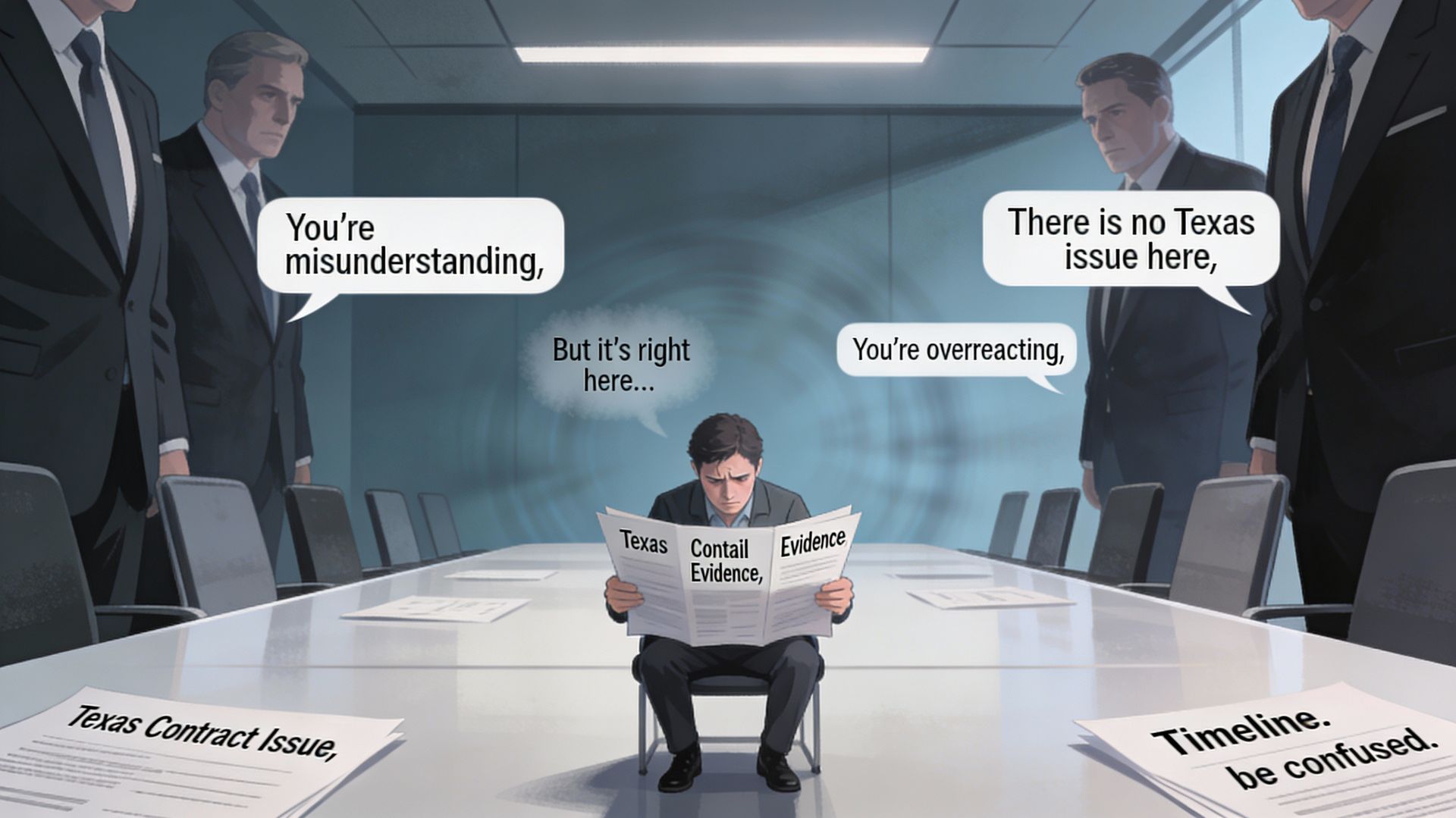
Corporate gaslighting often begins in conference rooms and email chains, long before anyone steps into a courtroom. A lone customer or small business owner sits surrounded by well-dressed professionals who confidently deliver phrases like:
“You’re misunderstanding.”
“There is no Texas issue here.”
“You’re overreacting.”
The person in the middle holds actual evidence—contracts, state-law citations, timelines—but the room responds as if the documents do not exist. The message is subtle but brutal: Your evidence is invisible because we say so. Over time, repeated dismissal can make even a careful, detail‑driven person question their own reading of plain language on the page.
How The Strings Get Pulled In Court
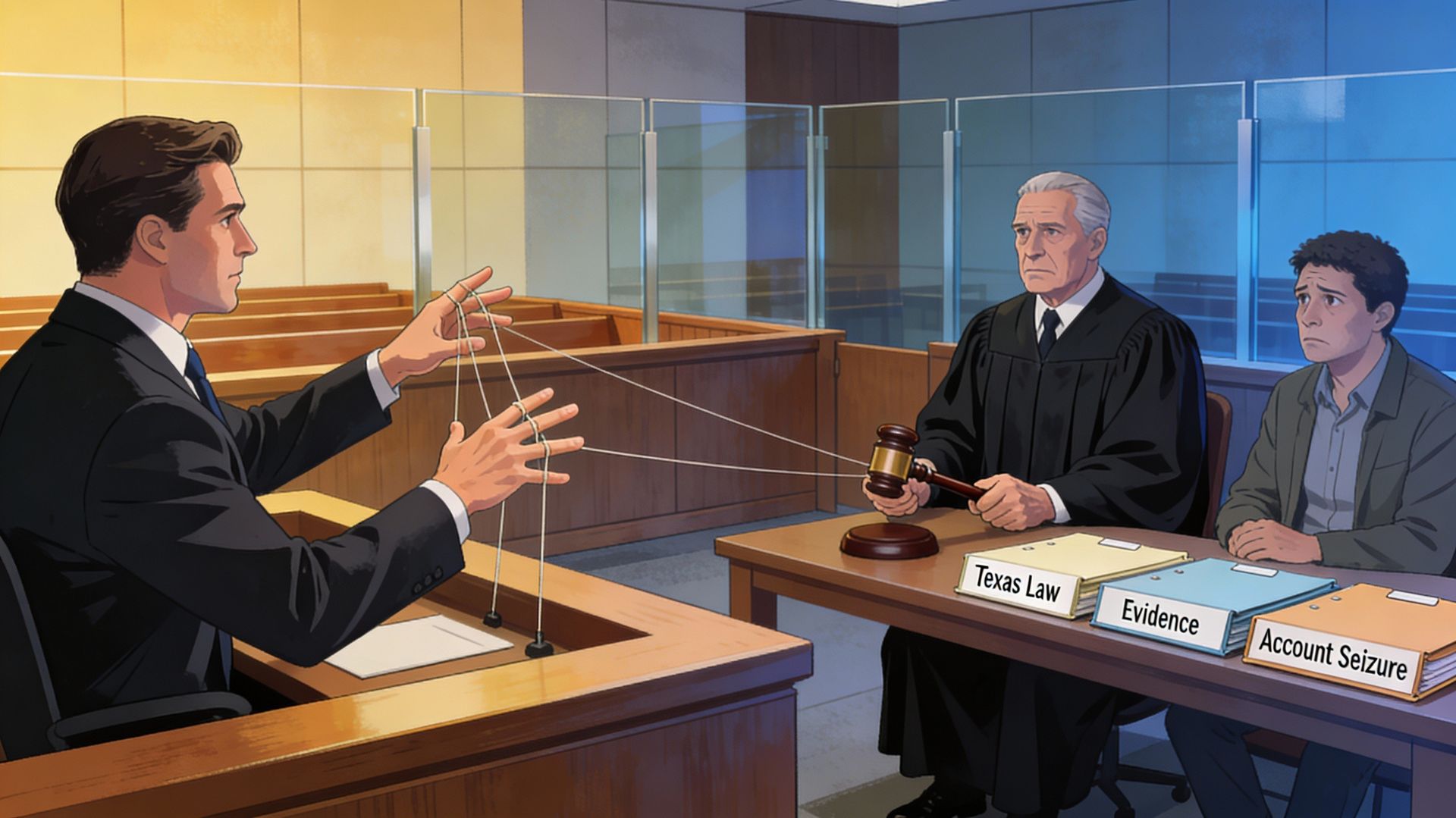
The most dangerous gaslighting happens when narratives walk through the courthouse doors. A corporate lawyer can frame the dispute so narrowly that the judge never sees the full context. Instead of “unauthorized seizure under state law,” the issue becomes “routine judgment enforcement” or a “misunderstanding about procedure.”
In the image, the attorney is literally pulling strings tied to the judge’s gavel, while folders labeled “Texas Law,” “Evidence,” and “Account Seizure” sit on the bench. That is the power dynamic: if the story is framed correctly for the court, key issues can be kept out of reach. For a self‑represented litigant, the challenge is forcing the judge to pick up the right folder—the one where the paper trail lives.
Words In The Air vs. Documents On The Table

Corporate gaslighting lives in the gap between spoken assurances and written reality. On one side are the comforting phrases:
“No jurisdiction.”
“We did nothing wrong.”
“You’re misunderstanding.”
Those sentences float like smoke: easy to say, hard to pin down. On the other side are the bound volumes of documents—state statutes, court rules, account records, and internal policies. They may show an undomesticated out‑of‑state judgment being enforced anyway, a debtor‑in‑possession (DIP) account treated like ordinary collateral, or funds taken beyond what any judgment could justify.
When you live through this, you learn a hard rule: never chase the smoke; stay with the paper. Ask, “Where is that in writing?” and “Show me the authority.” If the words in the air do not match the documents on the table, believe the documents.
Turning On The Lights: Record, Emails, Filings, Complaints
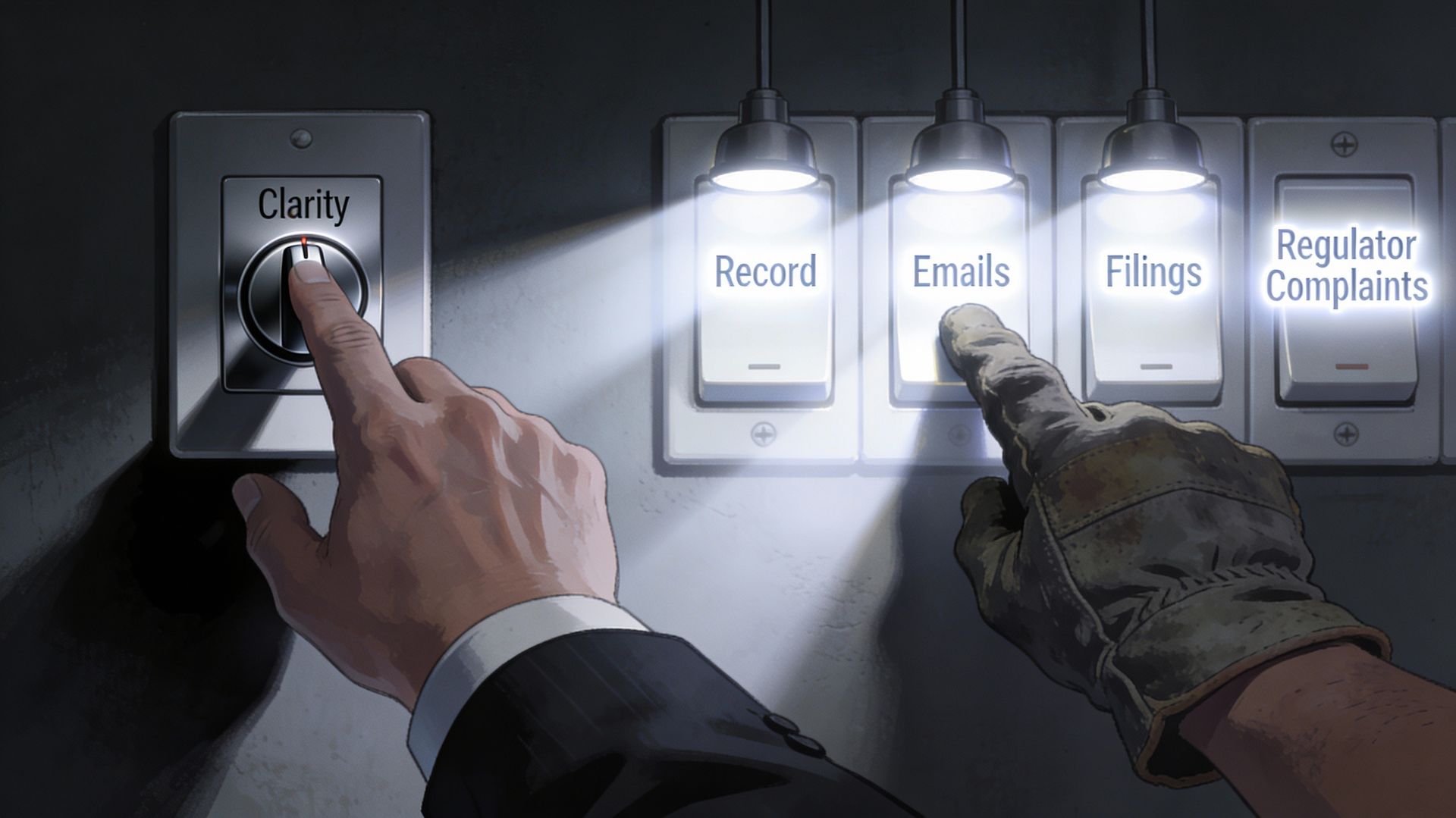
The antidote to gaslighting is organized, verifiable documentation. Clarity is not a feeling; it is a system you build. Think of each switch in this image as a category you control:
Record – Keep your own complete record of events, from the first problem to the latest filing.
Emails – Save and organize every email; treat them as sworn testimony that has not been sworn in yet.
Filings – Track each court filing, response, and order, and map what arguments are actually before the judge.
Regulator Complaints – Document your reports to banking regulators, consumer agencies, and oversight bodies.
When all of these are “lit,” the corporate narrative has fewer dark corners to hide in. You are not relying on memory; you are relying on timestamps, file names, and PDFs.
The Distorted Mirror: How Gaslighting Shapes Self‑Perception
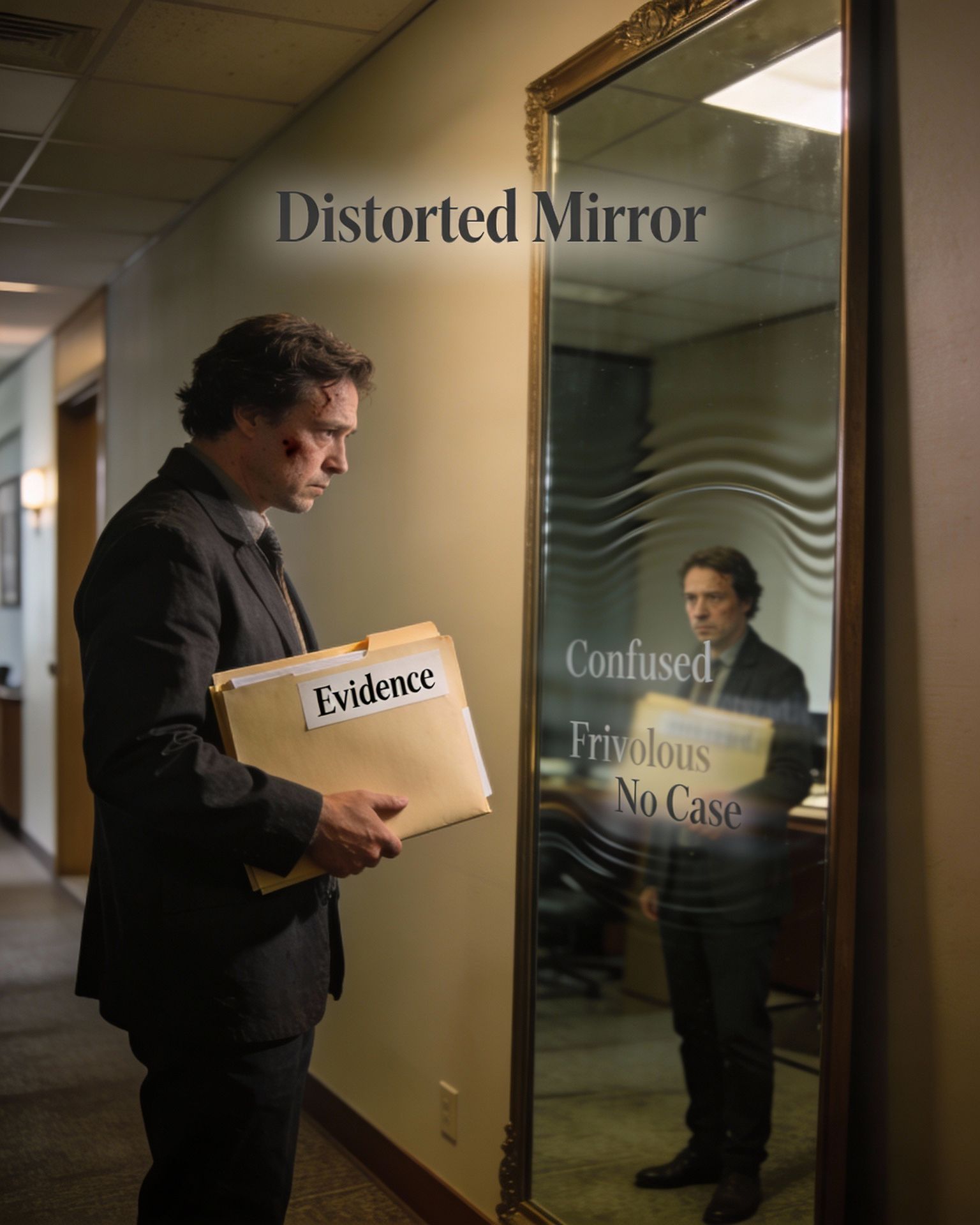
Corporate gaslighting is not only external; it seeps into how you see yourself. You can walk into an office carrying a thick folder of evidence and still feel like the reflection in the mirror: confused, frivolous, and without a real case. The longer an institution denies obvious facts, the more it tries to turn “You have a strong claim” into “You are overreacting.”
The distorted mirror tells you your injuries are minor, your questions are naive, and your insistence on clear answers is a personal flaw. The real turning point comes when you realize the distortion is not in you—it is in the way the institution wants you to see yourself. The documents in your hands are reality; the labels on the mirror are strategy.
Email Storms And The Power Of A Timeline

When a dispute heats up, one classic tactic is to bury you in an email storm. On the left side of the image, a person sits surrounded by messages: “File in NY,” “No Texas matter here,” “You’re violating the rules,” “Urgent response required.” Each email demands fast reaction, keeping you too busy to step back and see the big picture.
On the right side is the antidote: a simple, factual timeline. For example:
Judgment entered.
No domestication in the enforcing state.
Account seizure in 2019.
Key confirming email in 2022.
Once you map the story as a sequence of dated events, contradictions become obvious. Suddenly, the gaslighting phrases do not match the history they themselves created. Courts and regulators respond far better to a one‑page timeline with citations than to a thousand emotional emails.
The Courtroom Illusion: When Gaslighting Becomes A Glass Wall
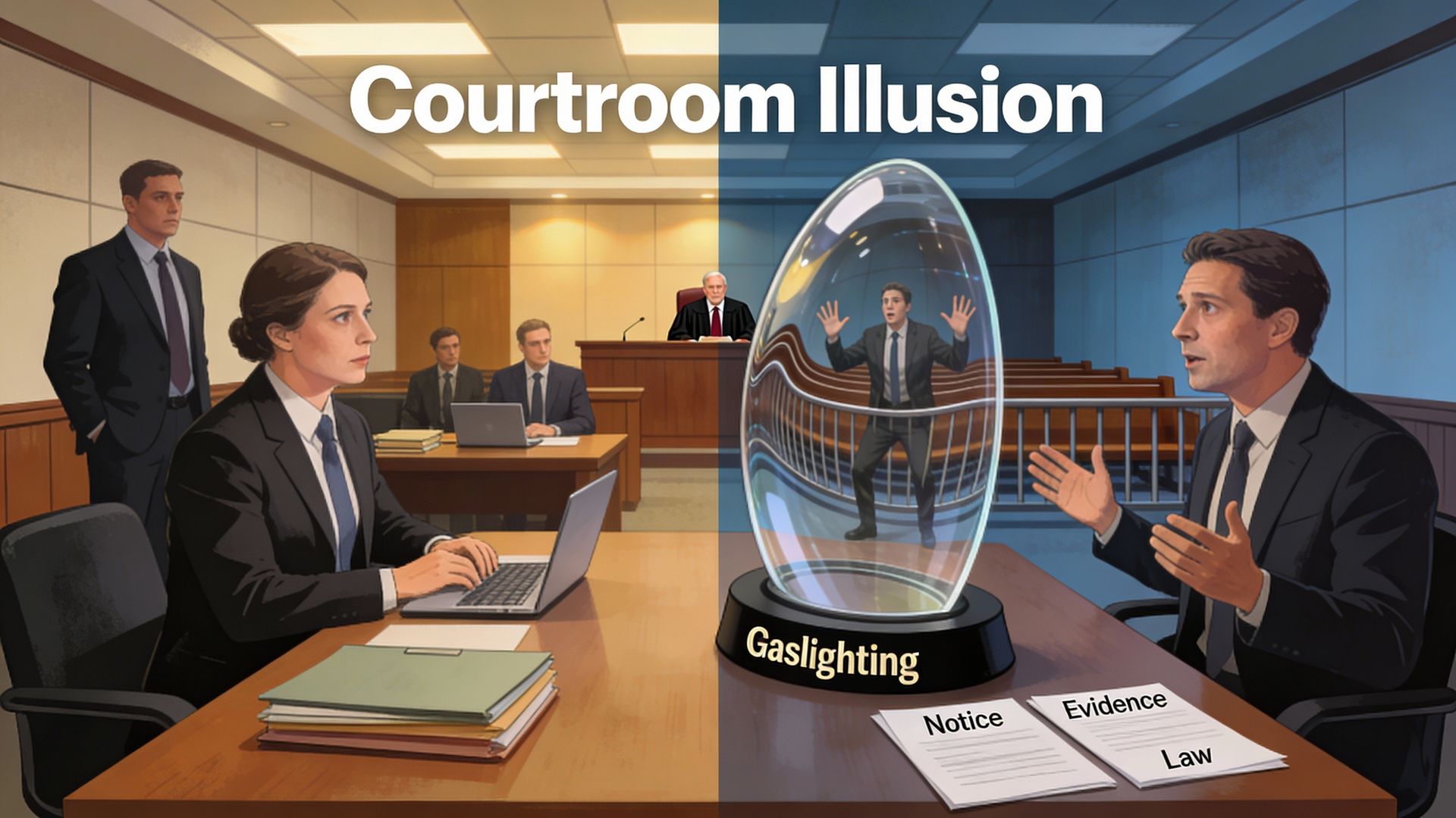
The final stage of corporate gaslighting is the courtroom illusion. On one side of the courtroom, a team sits calmly with laptops and binders. On the other side, a self‑represented person or small‑firm lawyer tries to speak through an invisible barrier. Every time they raise notice, evidence, or law, it feels like their words bend and vanish inside a glass bubble.
This is where clarity, timelines, and documentation matter most. Courts can be misled by smooth narratives, but they are ultimately bound by the record. The key is getting the right facts and statutes into that record in a form the court must address: sworn declarations, authenticated exhibits, precise references to state law, and focused motions. The more you can pierce the illusion with organized evidence, the harder it is for anyone—bank or judge—to pretend the issues do not exist.
Surviving Corporate Gaslighting
If you are living through a similar battle, a few principles help keep you grounded:
Believe documents over verbal assurances.
Build your own record; never rely on the institution’s files alone.
Turn chaos into a timeline to expose contradictions.
Separate how they describe you from what the evidence actually shows.
Measure progress not by how understood you feel, but by what is now in the official record.
Corporate gaslighting thrives in confusion, delay, and shame. The moment you replace confusion with clarity, delay with documented timelines, and shame with grounded confidence in your own evidence, the game changes. You may still face resistance, but you are no longer arguing about your sanity—you are arguing about the facts.